Advanced Topics
These are features for advanced set ups.
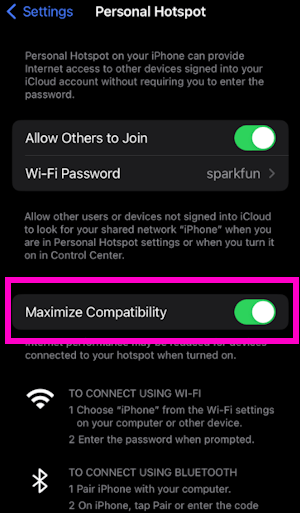
:::2.4GHz Limited The FPL uses 2.4GHz only. iPhones and some WiFi networks operate at higher 5.5GHz frequencies. Be sure to enable 'Maximize Compatibility' on iOS devices to allow 2.4GHz connections. :::
L-Band Service
Some companies broadcast an extra signal over geosynchronous satellites in something called the 'L-Band' which is really just a catch-all name for any broadcast between 1GHz and 2GHz. Because GNSS satellites broadcast their signal at ~1.57GHz (L1) and ~1.23GHz (L2), it is beneficial to broadcast an extra signal near these frequencies because the GNSS receiver hardware can be adapted to pick up this extra signal. Depending on the company, this signal adds additional correction data that can allow a GNSS receiver to obtain much higher accuracy than L1/L2/L5 positioning alone. But because broadcasting on satellites is exorbitantly expensive, the signal is often encrypted to force users to pay a subscription fee. The benefit of L-Band corrections is that they can cover an entire country or continent with corrections, without the need for internet connectivity, allowing for remote location to be surveyed, or scientific research conducted.
Base/Rover Setup
A base can be set on site and surveyed in with high accuracy in about 12 hours. Once that is completed a base can transmit corrections to the rover allowing the rover to obtain RTK Fix with high absolute accuracy. The connection between the rover and base can be accomplished with a variety of options. Please see Correction Transport for more information.